3 Frameworks That Will Save You Time & Headaches as a Content Creator
Modern creators need to understand these 3 key things
Marketing
Mar 19, 2023

So you’ve finally decided to jump on the social media bandwagon and start creating content.
It takes you 2 weeks to record 3 days' worth of cool content. And then you release it all.
7 views 0 comments
Your content well has run dry and you don’t even have the positive reinforcement to create some more.
It seems a lot easier when other people do it, huh? I mean there has to be some type of secret sauce that allows these content creators to pump out multiple pieces of content a day without missing a beat.
Truthfully, there are tons of secrets and tricks.
…but secrets aren’t going to get you your desired results. The thing that’s going to make you a content-producing machine and take your brand to new heights is something you’ve heard a thousand times but continue to ignore.
The thing you need is a system.
I’ve spent the past 3 years refining my content creation system so that it works for my working style and objectives. I will share a summary of that system with you today. Keep in mind though, that you will have to adapt this to your own objectives and business. So use this article as a building block to create your own frameworks and best practices.
Let’s get into it.
“Ideas in secret die. They need light and air or they starve to death.”
— Seth Godin
1. Weekly Content Sprints
Unless you’re starting a meme page on Instagram, which can be profitable, then it’s not in your best interest to post for the sake of posting. As entrepreneurs, we need to be as efficient as possible with our time and our resources. Before I create anything, I define the purpose of the content.
Am I looking to grow my followers by 20% on a single platform?
Do I want to get people to register for my event in 14 days?
Regardless of what I would like to see happen, the first step in defining my content strategy is coming up with a specific campaign objective and timeline. From there, I can plan my content out in sprints and remove the need to guess what I will create next.
Next, I take my campaign objective and create a monthly objective table that maps toward my larger goal. Let me give you an example of creating monthly objectives that align with your campaign objective:
One of my clients wants more people to purchase her course. So her campaign objective is to drive traffic to her sales page.
With that objective in mind, I created a 3-month content plan with these specific themes for each month:
Month 1: Awareness and Storytelling
Month 2: Pilot Student Success
Month 3: Direct CTA & Urgency
Now that I know what I want her content to accomplish each month, I break it down even further into separate weekly sprints.
For the sake of brevity, I will include a graphic of the plan I created to illustrate what this looks like in practice:
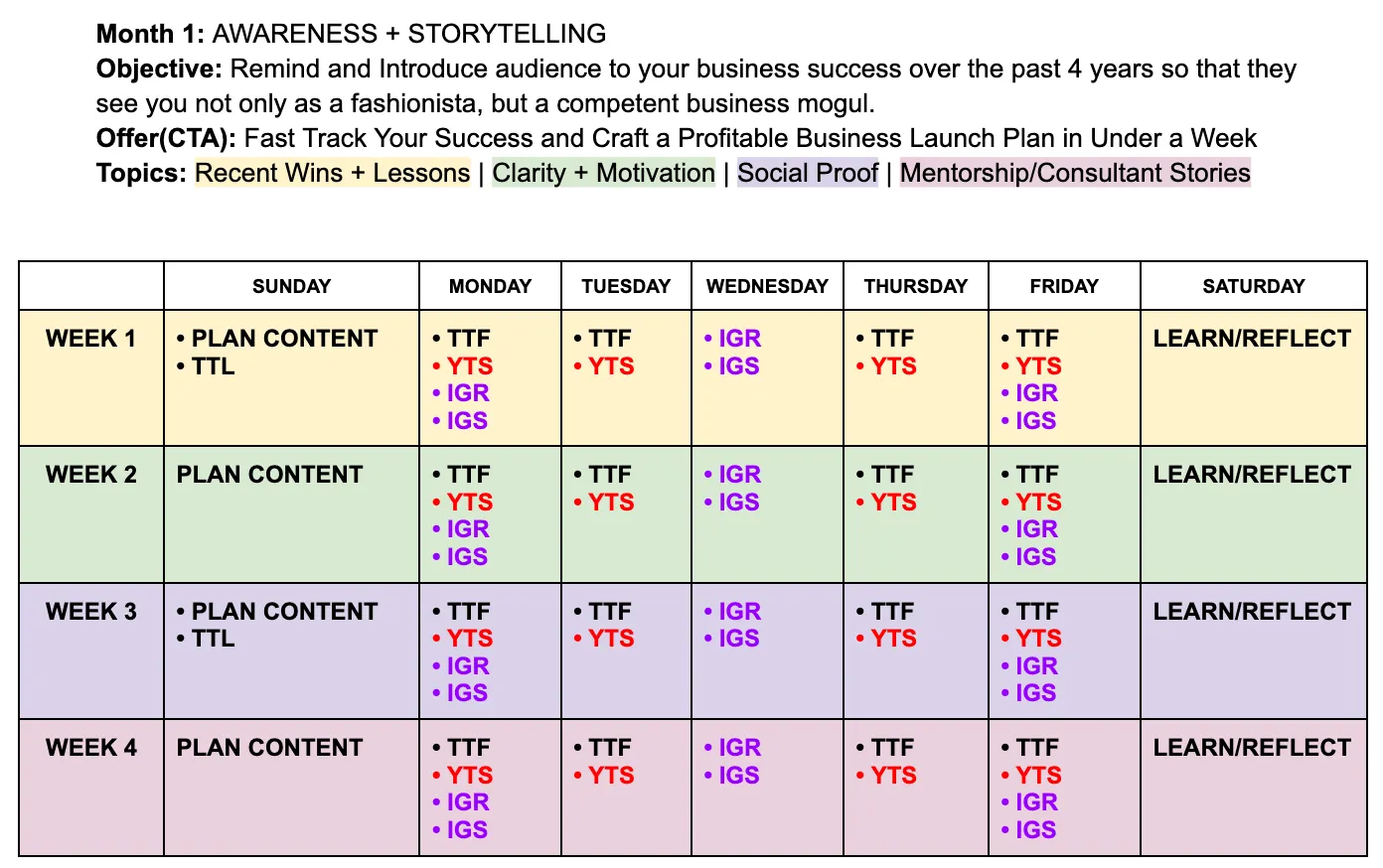
If you analyze the graphic above, you will see the theme for the month followed by the objective. Then, there is a specific call to action for the month that is broken down into weekly topics. These weekly sprints of content are meant to cognitively shepherd the audience exactly where I want them to go.
See from here we can talk about platforms, content types, etc. But none of that matters if you don’t have your objectives set from the beginning.
If you can maintain some type of structure similar to this, you will save yourself hours in planning each week and tons of headaches in trying to figure out what to make.
2. Trey Dub (Who, What, Why)
Once I have my content plan and structure solidified, it’s time for the fun part. It’s time to sit down and determine what the content will be for each day. At this point, I like to rely on what I call the Trey Dub (3 W’s) framework.
Consumers, viewers, audiences, etc. are bombarded with content all day long. Since there are tons of people and platforms competing for their attention at any given time, it’s super important that you speak directly to people and communicate value quickly.
I created this framework as a way to ensure that content is always contextual and has value built into it.
Here is the Trey Dub framework in practice:
Who
Who is this content for?
And I want you to call them out by name. For example:
Are you tired of wasting money on screen protectors that don’t protect your phone?
or
Let me tell you why every tech founder in Atlanta is signing up for this mixer.
Do you see what I did in the above examples? I quickly and clearly called out the type of person that I wanted to stop and view my content.
Remember, there are so many additional places for people to place their attention. If people don’t feel like the content is for them, they will move on.
What
What do you want people to know?
This is the value.
This is where you communicate your ideas, point of view, or offer to the customer avatar above. The way you execute this is up to you and I can’t get into each of the nuances in this post. What I will suggest though, is that you keep this point clear, concise, and leave the viewer wanting more.
If you leave people wanting to hear more, then you open up the opportunity for them to investigate your brand further and you get closer to your desired outcome.
Why
Why should they care?
You know this question is going to come up so why not beat them to the punch? I try to make sure all of my content has a purpose outside of the value itself.
Yes, I am a tech founder in Atlanta that wants to find investors. But why should I take action now? Why should I come to YOUR event on THIS date? And why should I RSVP with the link in your bio instead of just showing up at the door?
The “why” is arguably the most important part of this entire framework. It essentially determines whether your content will encourage action or not. It determines whether people will bookmark your content or share it with a friend. All of these post-consumption activities are important because they are the goal after all.
Once I’ve laid out my content strategy and determined what content I will create each day, it’s time for distribution. This is where I institute my R.I.S.K. framework.
3. R.I.S.K.
Whether we like to admit it or not, marketing is testing. Yes, we can read about all of these best practices and ask A.I. to tell us the best time to post on LinkedIn. But at the end of the day, these are merely assumptions and hypotheses until we execute and track performance. An easy approach to this stage of content creation is to use the following framework:
Release
Your favorite artist probably has 100 unreleased songs sitting on a computer. You probably have dozens of unfinished pieces in your Canva account. You don’t get any value out of content that is sitting in the cloud taking up storage space. Once you make it, you have to release it.
Allow it to permeate the internet and influence the greater dialogue. Or release it and watch it suffer a slow and painful death.
Regardless, both of these outcomes are indicators. They tell you something about the content you just put out — which leads to the next pillar.
Identify Trends
Does your content get a lot of engagement early and then drop off after 30 minutes?
Do more people seem to leave comments when you have a clear call to action at the beginning?
Does your audience find your sense of humor offensive?
It’s important to identify how your audience reacts to different types of content so that you can continually optimize your strategy. Remember, marketing is testing. This pillar of the R.I.S.K. framework is the most important because it informs how you will proceed from here.
Sustain
You can take this pillar two ways.
Your content has been deemed a success and it’s a cause for celebration. You have managed to break through the social media algorithms and will be swimming in riches soon.
2. It means that you received a positive indicator from your prior analysis. So there should be a succession, or follow-up, of the same type of content that performed well. When you have any type of traction with your content, do your best to maintain it because it’s easier to push an object forward that is already in motion.
Kill
This is the content graveyard. No, but seriously, some content needs to be decommissioned if you find that it doesn’t work.
Maybe it’s too offensive for your target audience.
Maybe you’re dealing with a more sophisticated consumer who is tired of the same messaging.
There’s nothing wrong with finding out that your content doesn’t work.
It just means that you have to go back to the beginning of R.I.S.K. and identify the things that do work so that you can double down on those.
“Entrepreneurial success and wealth creation, as well as wealth attraction, requires a willingness to risk and experience failure, and the emotional resiliency to recover from it quickly, decisively, passionately, and persistently.”
— Dan Kennedy
We’ve talked about a lot here. Again, these frameworks have been years in the making for me so don’t be discouraged if it seems like a lot to consider.
The purpose of this whole thing is to get you to start thinking systematically about your content so that you never feel like you don’t know where to start.
Creating content to promote yourself on the internet is a long game and can sometimes be unforgiving.
However, the evidence is clear as day that those who know how to leverage the internet to build a brand will see outsized returns over a long enough time horizon.
So keep on creating, and keep on finding ways to remove friction from your process.
More to READ

3 Frameworks That Will Save You Time & Headaches as a Content Creator
Modern creators need to understand these 3 key things
Marketing
Mar 19, 2023
So you’ve finally decided to jump on the social media bandwagon and start creating content.
It takes you 2 weeks to record 3 days' worth of cool content. And then you release it all.
7 views 0 comments
Your content well has run dry and you don’t even have the positive reinforcement to create some more.
It seems a lot easier when other people do it, huh? I mean there has to be some type of secret sauce that allows these content creators to pump out multiple pieces of content a day without missing a beat.
Truthfully, there are tons of secrets and tricks.
…but secrets aren’t going to get you your desired results. The thing that’s going to make you a content-producing machine and take your brand to new heights is something you’ve heard a thousand times but continue to ignore.
The thing you need is a system.
I’ve spent the past 3 years refining my content creation system so that it works for my working style and objectives. I will share a summary of that system with you today. Keep in mind though, that you will have to adapt this to your own objectives and business. So use this article as a building block to create your own frameworks and best practices.
Let’s get into it.
“Ideas in secret die. They need light and air or they starve to death.”
— Seth Godin
1. Weekly Content Sprints
Unless you’re starting a meme page on Instagram, which can be profitable, then it’s not in your best interest to post for the sake of posting. As entrepreneurs, we need to be as efficient as possible with our time and our resources. Before I create anything, I define the purpose of the content.
Am I looking to grow my followers by 20% on a single platform?
Do I want to get people to register for my event in 14 days?
Regardless of what I would like to see happen, the first step in defining my content strategy is coming up with a specific campaign objective and timeline. From there, I can plan my content out in sprints and remove the need to guess what I will create next.
Next, I take my campaign objective and create a monthly objective table that maps toward my larger goal. Let me give you an example of creating monthly objectives that align with your campaign objective:
One of my clients wants more people to purchase her course. So her campaign objective is to drive traffic to her sales page.
With that objective in mind, I created a 3-month content plan with these specific themes for each month:
Month 1: Awareness and Storytelling
Month 2: Pilot Student Success
Month 3: Direct CTA & Urgency
Now that I know what I want her content to accomplish each month, I break it down even further into separate weekly sprints.
For the sake of brevity, I will include a graphic of the plan I created to illustrate what this looks like in practice:
If you analyze the graphic above, you will see the theme for the month followed by the objective. Then, there is a specific call to action for the month that is broken down into weekly topics. These weekly sprints of content are meant to cognitively shepherd the audience exactly where I want them to go.
See from here we can talk about platforms, content types, etc. But none of that matters if you don’t have your objectives set from the beginning.
If you can maintain some type of structure similar to this, you will save yourself hours in planning each week and tons of headaches in trying to figure out what to make.
2. Trey Dub (Who, What, Why)
Once I have my content plan and structure solidified, it’s time for the fun part. It’s time to sit down and determine what the content will be for each day. At this point, I like to rely on what I call the Trey Dub (3 W’s) framework.
Consumers, viewers, audiences, etc. are bombarded with content all day long. Since there are tons of people and platforms competing for their attention at any given time, it’s super important that you speak directly to people and communicate value quickly.
I created this framework as a way to ensure that content is always contextual and has value built into it.
Here is the Trey Dub framework in practice:
Who
Who is this content for?
And I want you to call them out by name. For example:
Are you tired of wasting money on screen protectors that don’t protect your phone?
or
Let me tell you why every tech founder in Atlanta is signing up for this mixer.
Do you see what I did in the above examples? I quickly and clearly called out the type of person that I wanted to stop and view my content.
Remember, there are so many additional places for people to place their attention. If people don’t feel like the content is for them, they will move on.
What
What do you want people to know?
This is the value.
This is where you communicate your ideas, point of view, or offer to the customer avatar above. The way you execute this is up to you and I can’t get into each of the nuances in this post. What I will suggest though, is that you keep this point clear, concise, and leave the viewer wanting more.
If you leave people wanting to hear more, then you open up the opportunity for them to investigate your brand further and you get closer to your desired outcome.
Why
Why should they care?
You know this question is going to come up so why not beat them to the punch? I try to make sure all of my content has a purpose outside of the value itself.
Yes, I am a tech founder in Atlanta that wants to find investors. But why should I take action now? Why should I come to YOUR event on THIS date? And why should I RSVP with the link in your bio instead of just showing up at the door?
The “why” is arguably the most important part of this entire framework. It essentially determines whether your content will encourage action or not. It determines whether people will bookmark your content or share it with a friend. All of these post-consumption activities are important because they are the goal after all.
Once I’ve laid out my content strategy and determined what content I will create each day, it’s time for distribution. This is where I institute my R.I.S.K. framework.
3. R.I.S.K.
Whether we like to admit it or not, marketing is testing. Yes, we can read about all of these best practices and ask A.I. to tell us the best time to post on LinkedIn. But at the end of the day, these are merely assumptions and hypotheses until we execute and track performance. An easy approach to this stage of content creation is to use the following framework:
Release
Your favorite artist probably has 100 unreleased songs sitting on a computer. You probably have dozens of unfinished pieces in your Canva account. You don’t get any value out of content that is sitting in the cloud taking up storage space. Once you make it, you have to release it.
Allow it to permeate the internet and influence the greater dialogue. Or release it and watch it suffer a slow and painful death.
Regardless, both of these outcomes are indicators. They tell you something about the content you just put out — which leads to the next pillar.
Identify Trends
Does your content get a lot of engagement early and then drop off after 30 minutes?
Do more people seem to leave comments when you have a clear call to action at the beginning?
Does your audience find your sense of humor offensive?
It’s important to identify how your audience reacts to different types of content so that you can continually optimize your strategy. Remember, marketing is testing. This pillar of the R.I.S.K. framework is the most important because it informs how you will proceed from here.
Sustain
You can take this pillar two ways.
Your content has been deemed a success and it’s a cause for celebration. You have managed to break through the social media algorithms and will be swimming in riches soon.
2. It means that you received a positive indicator from your prior analysis. So there should be a succession, or follow-up, of the same type of content that performed well. When you have any type of traction with your content, do your best to maintain it because it’s easier to push an object forward that is already in motion.
Kill
This is the content graveyard. No, but seriously, some content needs to be decommissioned if you find that it doesn’t work.
Maybe it’s too offensive for your target audience.
Maybe you’re dealing with a more sophisticated consumer who is tired of the same messaging.
There’s nothing wrong with finding out that your content doesn’t work.
It just means that you have to go back to the beginning of R.I.S.K. and identify the things that do work so that you can double down on those.
“Entrepreneurial success and wealth creation, as well as wealth attraction, requires a willingness to risk and experience failure, and the emotional resiliency to recover from it quickly, decisively, passionately, and persistently.”
— Dan Kennedy
We’ve talked about a lot here. Again, these frameworks have been years in the making for me so don’t be discouraged if it seems like a lot to consider.
The purpose of this whole thing is to get you to start thinking systematically about your content so that you never feel like you don’t know where to start.
Creating content to promote yourself on the internet is a long game and can sometimes be unforgiving.
However, the evidence is clear as day that those who know how to leverage the internet to build a brand will see outsized returns over a long enough time horizon.
So keep on creating, and keep on finding ways to remove friction from your process.
More to READ
3 Frameworks That Will Save You Time & Headaches as a Content Creator
Modern creators need to understand these 3 key things
Marketing
Mar 19, 2023
So you’ve finally decided to jump on the social media bandwagon and start creating content.
It takes you 2 weeks to record 3 days' worth of cool content. And then you release it all.
7 views 0 comments
Your content well has run dry and you don’t even have the positive reinforcement to create some more.
It seems a lot easier when other people do it, huh? I mean there has to be some type of secret sauce that allows these content creators to pump out multiple pieces of content a day without missing a beat.
Truthfully, there are tons of secrets and tricks.
…but secrets aren’t going to get you your desired results. The thing that’s going to make you a content-producing machine and take your brand to new heights is something you’ve heard a thousand times but continue to ignore.
The thing you need is a system.
I’ve spent the past 3 years refining my content creation system so that it works for my working style and objectives. I will share a summary of that system with you today. Keep in mind though, that you will have to adapt this to your own objectives and business. So use this article as a building block to create your own frameworks and best practices.
Let’s get into it.
“Ideas in secret die. They need light and air or they starve to death.”
— Seth Godin
1. Weekly Content Sprints
Unless you’re starting a meme page on Instagram, which can be profitable, then it’s not in your best interest to post for the sake of posting. As entrepreneurs, we need to be as efficient as possible with our time and our resources. Before I create anything, I define the purpose of the content.
Am I looking to grow my followers by 20% on a single platform?
Do I want to get people to register for my event in 14 days?
Regardless of what I would like to see happen, the first step in defining my content strategy is coming up with a specific campaign objective and timeline. From there, I can plan my content out in sprints and remove the need to guess what I will create next.
Next, I take my campaign objective and create a monthly objective table that maps toward my larger goal. Let me give you an example of creating monthly objectives that align with your campaign objective:
One of my clients wants more people to purchase her course. So her campaign objective is to drive traffic to her sales page.
With that objective in mind, I created a 3-month content plan with these specific themes for each month:
Month 1: Awareness and Storytelling
Month 2: Pilot Student Success
Month 3: Direct CTA & Urgency
Now that I know what I want her content to accomplish each month, I break it down even further into separate weekly sprints.
For the sake of brevity, I will include a graphic of the plan I created to illustrate what this looks like in practice:
If you analyze the graphic above, you will see the theme for the month followed by the objective. Then, there is a specific call to action for the month that is broken down into weekly topics. These weekly sprints of content are meant to cognitively shepherd the audience exactly where I want them to go.
See from here we can talk about platforms, content types, etc. But none of that matters if you don’t have your objectives set from the beginning.
If you can maintain some type of structure similar to this, you will save yourself hours in planning each week and tons of headaches in trying to figure out what to make.
2. Trey Dub (Who, What, Why)
Once I have my content plan and structure solidified, it’s time for the fun part. It’s time to sit down and determine what the content will be for each day. At this point, I like to rely on what I call the Trey Dub (3 W’s) framework.
Consumers, viewers, audiences, etc. are bombarded with content all day long. Since there are tons of people and platforms competing for their attention at any given time, it’s super important that you speak directly to people and communicate value quickly.
I created this framework as a way to ensure that content is always contextual and has value built into it.
Here is the Trey Dub framework in practice:
Who
Who is this content for?
And I want you to call them out by name. For example:
Are you tired of wasting money on screen protectors that don’t protect your phone?
or
Let me tell you why every tech founder in Atlanta is signing up for this mixer.
Do you see what I did in the above examples? I quickly and clearly called out the type of person that I wanted to stop and view my content.
Remember, there are so many additional places for people to place their attention. If people don’t feel like the content is for them, they will move on.
What
What do you want people to know?
This is the value.
This is where you communicate your ideas, point of view, or offer to the customer avatar above. The way you execute this is up to you and I can’t get into each of the nuances in this post. What I will suggest though, is that you keep this point clear, concise, and leave the viewer wanting more.
If you leave people wanting to hear more, then you open up the opportunity for them to investigate your brand further and you get closer to your desired outcome.
Why
Why should they care?
You know this question is going to come up so why not beat them to the punch? I try to make sure all of my content has a purpose outside of the value itself.
Yes, I am a tech founder in Atlanta that wants to find investors. But why should I take action now? Why should I come to YOUR event on THIS date? And why should I RSVP with the link in your bio instead of just showing up at the door?
The “why” is arguably the most important part of this entire framework. It essentially determines whether your content will encourage action or not. It determines whether people will bookmark your content or share it with a friend. All of these post-consumption activities are important because they are the goal after all.
Once I’ve laid out my content strategy and determined what content I will create each day, it’s time for distribution. This is where I institute my R.I.S.K. framework.
3. R.I.S.K.
Whether we like to admit it or not, marketing is testing. Yes, we can read about all of these best practices and ask A.I. to tell us the best time to post on LinkedIn. But at the end of the day, these are merely assumptions and hypotheses until we execute and track performance. An easy approach to this stage of content creation is to use the following framework:
Release
Your favorite artist probably has 100 unreleased songs sitting on a computer. You probably have dozens of unfinished pieces in your Canva account. You don’t get any value out of content that is sitting in the cloud taking up storage space. Once you make it, you have to release it.
Allow it to permeate the internet and influence the greater dialogue. Or release it and watch it suffer a slow and painful death.
Regardless, both of these outcomes are indicators. They tell you something about the content you just put out — which leads to the next pillar.
Identify Trends
Does your content get a lot of engagement early and then drop off after 30 minutes?
Do more people seem to leave comments when you have a clear call to action at the beginning?
Does your audience find your sense of humor offensive?
It’s important to identify how your audience reacts to different types of content so that you can continually optimize your strategy. Remember, marketing is testing. This pillar of the R.I.S.K. framework is the most important because it informs how you will proceed from here.
Sustain
You can take this pillar two ways.
Your content has been deemed a success and it’s a cause for celebration. You have managed to break through the social media algorithms and will be swimming in riches soon.
2. It means that you received a positive indicator from your prior analysis. So there should be a succession, or follow-up, of the same type of content that performed well. When you have any type of traction with your content, do your best to maintain it because it’s easier to push an object forward that is already in motion.
Kill
This is the content graveyard. No, but seriously, some content needs to be decommissioned if you find that it doesn’t work.
Maybe it’s too offensive for your target audience.
Maybe you’re dealing with a more sophisticated consumer who is tired of the same messaging.
There’s nothing wrong with finding out that your content doesn’t work.
It just means that you have to go back to the beginning of R.I.S.K. and identify the things that do work so that you can double down on those.
“Entrepreneurial success and wealth creation, as well as wealth attraction, requires a willingness to risk and experience failure, and the emotional resiliency to recover from it quickly, decisively, passionately, and persistently.”
— Dan Kennedy
We’ve talked about a lot here. Again, these frameworks have been years in the making for me so don’t be discouraged if it seems like a lot to consider.
The purpose of this whole thing is to get you to start thinking systematically about your content so that you never feel like you don’t know where to start.
Creating content to promote yourself on the internet is a long game and can sometimes be unforgiving.
However, the evidence is clear as day that those who know how to leverage the internet to build a brand will see outsized returns over a long enough time horizon.
So keep on creating, and keep on finding ways to remove friction from your process.